The research groups led by Professors Lu-Ming Duan, Dong-Ling Deng and Pan-Yu Hou at the Institute for Interdisciplinary Information Sciences (IIIS), Tsinghua University, have experimentally observed dynamical freezing in an interacting solid-state spin ensemble for the first time. Building upon this novel many-body phenomenon, the team developed a new approach to significantly enhance magnetic-field sensing. Their findings were recently published in Nature under the title, “Dynamical freezing for magnetometry in an interacting spin ensemble.”
Understanding and controlling non-equilibrium dynamics in quantum many-body systems is a fundamental challenge across condensed matter physics, atomic physics, and quantum information science. Generally, interacting quantum systems tend to thermalize during their dynamical evolution, causing the information encoded in their initial states and coherent features to rapidly dissipate. This problem is particularly pronounced in driven quantum systems, where external driving can continuously heat the system toward a featureless, "infinite-temperature" state, effectively erasing observable signals. While quantum thermalization is central to understanding non-equilibrium quantum matter, it severely hinders practical applications such as quantum sensing. In many quantum metrology platforms, unavoidable interactions between individual particles drive thermalization and decoherence, thereby limiting the optimal sensing time. Consequently, a long-standing goal in the field has been to suppress thermalization in interacting many-body systems, extend coherence times, and harness these effects to improve sensing performance. Previous approaches to thermalization breakdown have mainly relied on disorder-induced localization or high-frequency-driving-induced prethermalization. Recent theoretical studies proposed a distinct mechanism: under strong-amplitude, intermediate-frequency periodic driving, an interacting quantum many-body system may enter a dynamically frozen state protected by emergent conservation laws. However, observing this phenomenon in a large interacting quantum many-body system has remained challenging.

Figure 1. Schematic illustration of dynamical freezing in a diamond spin ensemble.
To address this challenge, the research group used an ensemble of approximately 10,000 interacting nitrogen-vacancy (NV) center electron spins in diamond as their experimental platform. The spins are initialized and read out with laser pulses and coherently controlled through global microwave fields. Under specific driving parameters, the interacting spin ensemble evolve into a special non-equilibrium dynamical state. Instead of rapidly thermalizing, the system maintained collective spin polarization over long evolution times, exhibiting a dynamically “frozen” behavior. The experiments showed that when the driving parameters satisfied specific freezing condition, the total spin magnetization remained stable for over 200 driving cycles, lasting more than an order of magnitude greater than the interaction-limited coherence time (see Figure 2). In contrast, when the driving parameters were tuned away from the freezing condition, the system quickly exhibited thermalizing behavior. These results demonstrate that the long-lived magnetization originates from emergent conservation laws induced by periodic driving. The emergent conserved quantity prevents the interacting spin ensemble from rapidly thermalizing, allowing coherence of the collective observable to persist far beyond the coherence time limited by interactions.
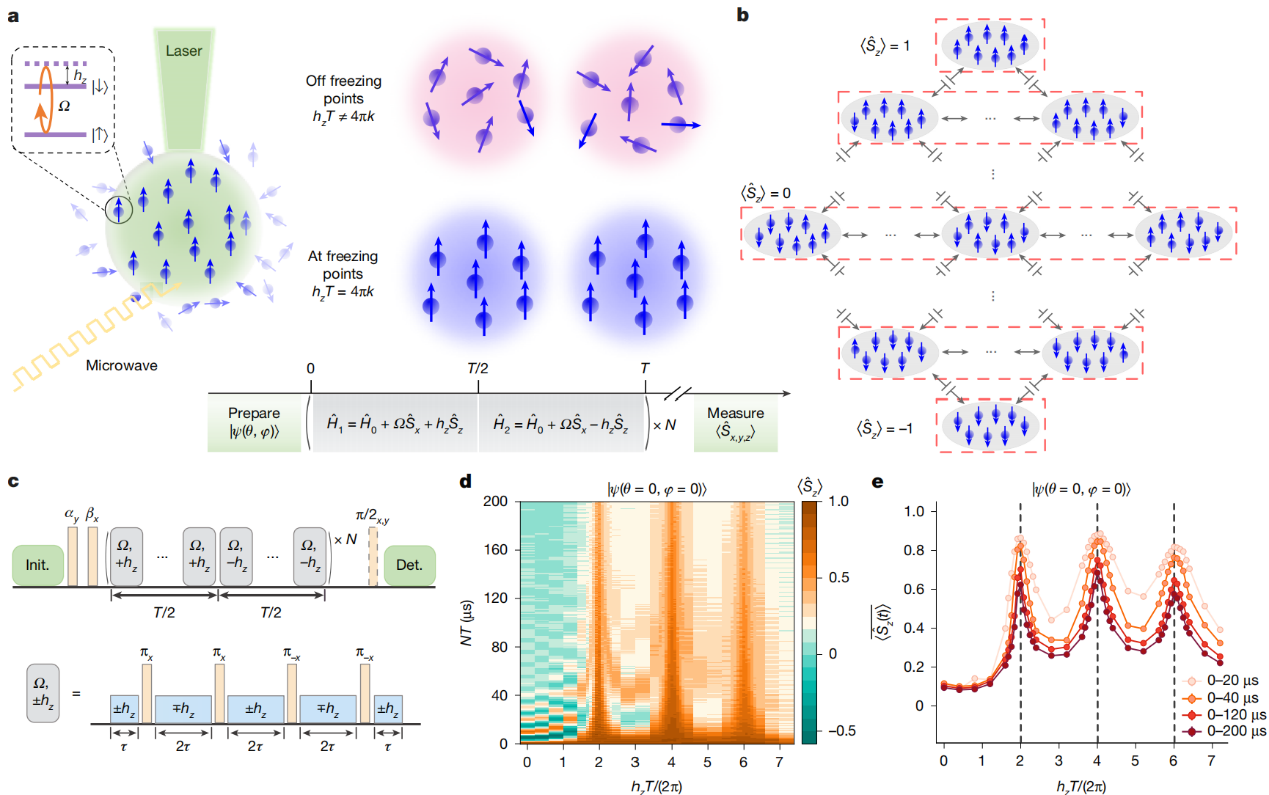
Figure 2. Dynamical freezing observed in an interacting NV-center spin ensemble.
Furthermore, the research group applied the dynamical freezing mechanism to magnetic-field sensing. Conventional quantum sensing protocols of ac fields typically rely on dynamical decoupling sequences to suppress environmental noise and extend coherence times. In strongly interacting spin ensembles, however, inter-particle interactions limit the optimal sensing time, therefore limiting measurement precision. This work demonstrates a different route: using emergent conserved quantities in a driven many-body system to protect collective spin response to external fields. Under identical experimental conditions, the new sensing protocol based on dynamical freezing achieved an approximately 2.7-fold improvement in sensitivity compared with conventional methods (see Figure 3). This approach overcomes the bottleneck posed by interactions and significantly enhances magnetic field sensing.
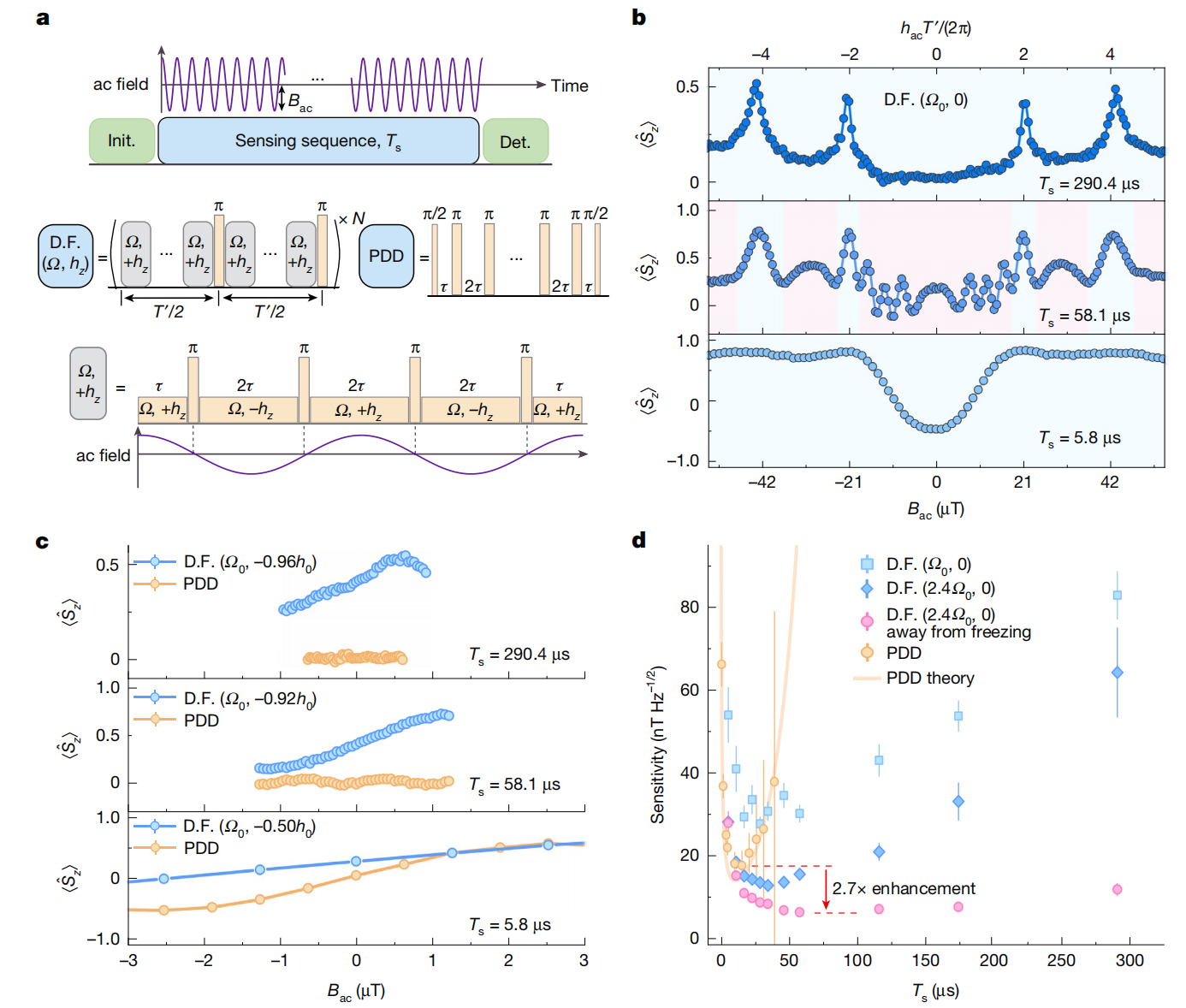
Figure 3. Magnetic-field sensing enhanced by the dynamical freezing mechanism.
This work reveals a novel mechanism for suppressing thermalization based on emergent conservation laws and opens a new direction for quantum sensing technologies built on quantum many-body physics. Because the approach requires only global control, it provides a promising route toward practical quantum sensing applications that combine high spatial resolution with high sensitivity. This may facilitate studies in condensed matter physics, chemistry, and biomedical science.
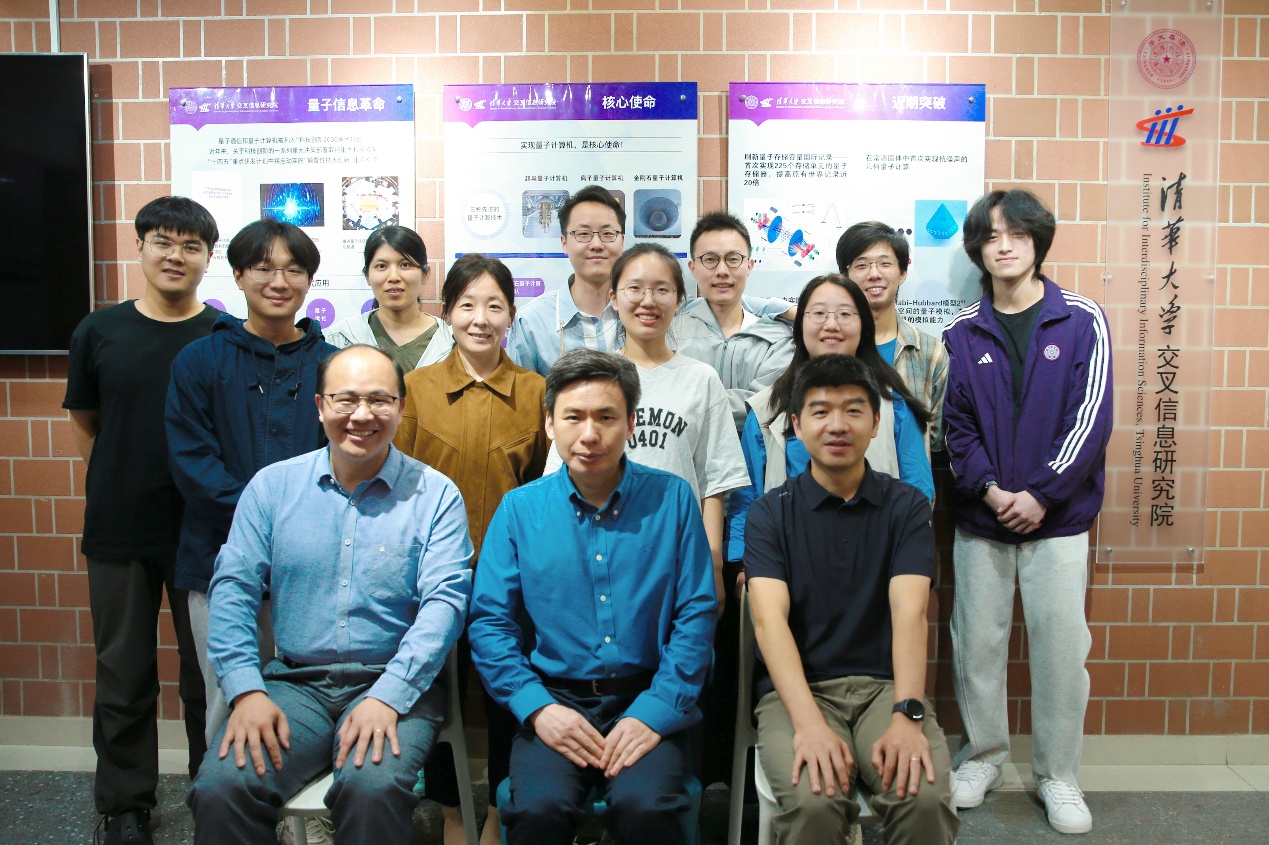
Group photo of the research team
The co-first authors of this paper are Postdoctoral Researcher Ya-Nan Lu and PhD candidate Dong Yuan, both from IIIS. The corresponding authors are Associate Professor Dong-Ling Deng, Professor Lu-Ming Duan, and Assistant Professor Pan-Yu Hou, all from IIIS. Assistant Professor Hong-Zheng Zhao from the School of Physics, Peking University contributed to this work.
This work was supported by Innovation Program for Quantum Science and Technology, the National Natural Science Foundation of China, the Tsinghua University Dushi Program, the Shanghai Qi Zhi Institute, the Tsinghua University Initiative Scientific Research Program and the Ministry of Education of China.
Paper link: //doi.org/10.1038/s41586-026-10585-6
Correspondent: Yueliang Mona Jiang
Editor: Xiamin Lv
Reviewer: Xiongfeng Ma